
ISO 9001 & AS9100 Certified CNC Manufacturing Facility
Robotics Manufacturing
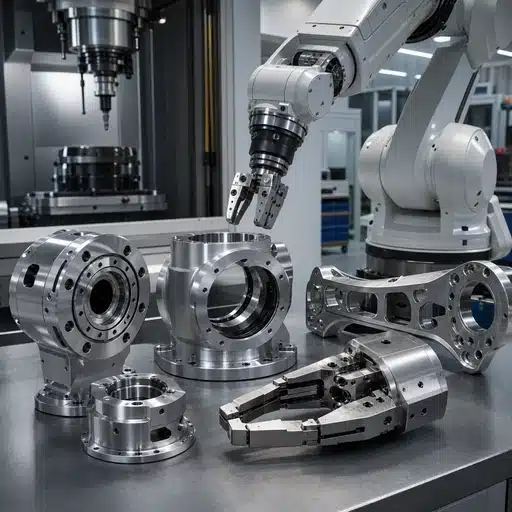
Robotics manufacturing produces the precision mechanical components, assemblies, and structural parts that power industrial robots, cobots, autonomous mobile robots, and humanoid systems. From the joint housings and bearing seats inside a robotic arm to the chassis frames and wheel mounts of an AGV, every part must hold tight tolerances, maintain repeatability, and survive continuous motion.
At Baetro, we support robotics manufacturing with precision CNC machining, 3D printing, sheet metal fabrication, and injection molding — delivering robot parts from our ISO-certified Qingdao facility to customers across North America, Europe, and Asia. Upload your CAD file for an instant quote with live pricing and lead times in under 60 seconds.
±0.001″
Machining tolerance
3–7 days
Standard lead time
Free DFM
On every quote
MOQ 1
Prototype to production
Robotics Manufacturing Fundamentals
What Is Robotics Manufacturing?
Robotics manufacturing covers the design, fabrication, assembly, and finishing of the mechanical parts and subsystems that make robots move, sense, and interact with their environment. The field spans industrial robot arms, collaborative robots, autonomous guided vehicles, humanoid systems, and medical robots, each with unique precision, weight, and durability requirements.
Most robot components start as a CAD model and move through machining, finishing, and inspection before assembly. Because small dimensional errors can stack across joints and reduce repeatability, CNC machining is often the preferred production method for critical robot parts. Learn more about how the broader sector is evolving in this overview of 2026 automation trends.
Precision at Scale
Critical components with tight tolerances for repeatable motion
Lightweight Materials
Aluminum, titanium, and engineered plastics for reduced inertia
Complex Geometries
Joint housings, curved links, and integrated bearing interfaces
Continuous Improvement
From prototypes to production — fast iteration with CNC machining

Your Robotics Manufacturing Partner
CNC machining, 3D printing, sheet metal, and injection molding for industrial robots, cobots, and autonomous systems.
Procurement confidence
Why Baetro for Robotics Manufacturing
Robot OEMs, automation startups, and R&D teams choose Baetro because we combine precision manufacturing with engineering partnership. Our experience spans the full range of robotics manufacturing — from cobot housings to AGV chassis.
Engineering-First Partnership
We do not just quote your part. Our engineers review every CAD file for manufacturability and often suggest design changes that reduce machining time and cost without compromising function. This free DFM feedback is included with every quote.
Transparent Manufacturing
We share pricing, lead times, and inspection requirements upfront. There are no hidden setup fees or tooling surprises. You see your exact price in under 60 seconds after uploading your CAD file.
Global Capability, Local Service
From our ISO-certified facility in Qingdao, we ship precision-machined robot parts to customers across North America, Europe, and Asia. Each order is assigned a dedicated English-speaking project manager who provides real-time updates from quote to delivery.
Speed Without Sacrificing Quality
Standard lead times are 3–7 days, and there is no minimum order quantity. Whether you need one prototype joint housing or a production run of AGV brackets, the process and quality standards remain the same.
Precision Tolerances for Robotics
Our precision CNC machining capabilities hold tolerances to ±0.001 inch — essential for joint interfaces, bearing seats, and structural links where dimensional accuracy directly affects robot repeatability and payload performance.
Full Traceability & Documentation
Every robotics order ships with material certifications, dimensional inspection reports, and full traceability. We support ISO 9001 and AS9100 workflows, with first article inspection reports available for critical safety-related components.
Robotics Components
Common CNC Machined Robot Parts
Baetro's CNC machining services cover the components that keep robots moving accurately. Typical robotics manufacturing projects include the following.
Structural & Drive Components
- Joint housings and reducer enclosures — protect gearboxes and maintain bearing alignment.
- Robot arm links and connecting blocks — rigid, lightweight structural members.
- Bearing seats and transmission shafts — precision fits for smooth rotation and load transfer.
- Servo motor mounts and brackets — secure alignment between motors and drivetrains.
Mounting & Accessory Components
- Gripper fingers and end-effector plates — custom interfaces for picking, welding, or inspection.
- Sensor housings and camera mounts — stable platforms for vision and proximity systems.
- AGV chassis frames and wheel mounts — durable bases for autonomous platforms.
- Battery supports and cable management brackets — organize power and signal routing.

Robot Part
Joint Housings
Protect gearboxes and maintain bearing alignment for smooth, repeatable motion.

Robot Part
Arm Links & Connecting Blocks
Rigid, lightweight structural members that connect joints and transmit loads.

Robot Part
End-Effectors & Grippers
Custom interfaces for picking, welding, inspection, and specialized tasks.

Robot Part
AGV Chassis & Mounts
Durable frames, wheel mounts, and brackets for autonomous mobile platforms.
Complex geometries — single setup.
Many of these parts require curved surfaces and multi-sided features. Our 5‑axis CNC machining centers machine these in one clamping, reducing stack‑up error and improving surface finish.
Material Selection
Materials and Tolerances for Robotics Manufacturing
Material selection in robotics manufacturing balances weight, stiffness, corrosion resistance, and cost. Baetro machines more than 50 materials, giving design teams the flexibility to match the right metal or plastic to each robot subsystem.
| Material Category | Common Grades | Typical Robot Applications |
|---|---|---|
| Aluminum alloys | 6061-T6, 7075-T6 | Robot arms, cobot housings, brackets, heat sinks |
| Stainless steel | 304, 316, 17-4 PH | Medical robot parts, corrosive environments, high-load brackets |
| Carbon/alloy steel | 4140, 4340 | Heavy-duty bases, mounting platforms, drive components |
| Titanium | Grade 5 (Ti-6Al-4V) | High-performance joints, medical/surgical instruments |
| Copper/brass | C110, C360 | Busbars, electrical connectors, motor terminals |
| Plastics/composites | PEEK, POM, nylon, polycarbonate | Insulation, lightweight covers, low-friction bushings |
Choosing the right material early prevents problems later. Aluminum keeps robot arms light and fast, while stainless steel and titanium handle sterilization and high loads. PEEK and other engineered plastics provide electrical insulation and low-friction surfaces for moving assemblies.
Our standard tolerance is ±0.001 inch (±0.025 mm), with tighter tolerances available for bearing bores, gear interfaces, and servo mounting planes. Every part is inspected on CMM equipment, and we provide full inspection reports, material certifications, and traceability documentation on request.
Engineering data
Tolerances & Precision for Robotics Manufacturing
In robotics, precision is not optional — it determines repeatability, payload accuracy, and system lifespan. At Baetro, we specify clear tolerance options for every robot component, from joint housings to end effectors.
Typical Robotics Tolerances
| Component / Feature | Standard Tolerance | Precision Tolerance |
|---|---|---|
| Linear dimensions — arm links (≤100 mm) | ±0.005" (±0.13 mm) | ±0.001" (±0.025 mm) |
| Linear dimensions — chassis (>100 mm) | ±0.010" (±0.25 mm) | ±0.002" (±0.05 mm) |
| Bearing bores and joint interfaces | ±0.002" (±0.05 mm) | ±0.001" (±0.025 mm) |
| Servo mounting planes | ±0.002" (±0.05 mm) | ±0.001" (±0.025 mm) |
| End-effector locating features | ±0.005" (±0.13 mm) | ±0.001" (±0.025 mm) |
| Angles — joint axes | ±0.5° | ±0.25° |
| Surface roughness (Ra) | 3.2 µm | 1.6 µm |
Precision tolerances are inspected on CMM equipment, with dimensional inspection reports available for shipment and quality review.
Precision for Robot Repeatability
- Standard tolerance: Suitable for structural frames, chassis, cable management brackets, and non‑critical prototype parts.
- Precision tolerance: Required for bearing seats, gear interfaces, servo mounting planes, and locating features. These directly affect robot repeatability, stiffness, and thermal stability.
- Cost impact: Precision tolerances typically add 20–50%, depending on geometry, material, and inspection requirements — a worthwhile investment for mission‑critical robot joints and drive trains.
- Engineering support: Upload your CAD files and our engineers will confirm achievable tolerances for your specific robot part geometry, material, and production volume.
Quality Assurance
Quality Control & Certifications for Robotics Manufacturing
Reliability in robotics manufacturing depends on consistent quality control. Baetro maintains ISO 9001 and AS9100 certified quality management systems, with inspection protocols designed for critical applications.
Our Quality Systems & Inspection Protocols
- ISO 9001 certified quality management system
- AS9100 certified for aerospace-grade quality standards
- Incoming material verification with full mill test reports
- In-process dimensional checks at multiple machining stages
- CMM inspection for complex geometries and tight tolerances
- Surface roughness testing to validate bearing and sealing surfaces
- First article inspection (FAI) for production approvals
- Full material traceability from raw stock to finished part
- 100% inspection or AQL sampling per customer requirements
What You Receive with Every Robotics Order
Every order includes comprehensive documentation to support assembly, validation, and field reliability of your robot components.
- Dimensional inspection reports with measurements against your drawing
- Material certification and full traceability to heat/lot number
- Surface finish verification when specified (Ra, Rz)
- Pass/fail status for all critical dimensions — bearing bores, joint interfaces, servo mounting planes
- First article inspection reports (FAIR) for production approval
- Inspector signature, inspection date, and customer sign-off section
- Digital and physical copies for your project records
Need deeper technical guidance? For a detailed look at robot part tolerances, inspection methods, and quality protocols, see this guide from XTJ-CNC – Custom CNC Machining for Industrial Robot Components. Our engineering team is also available to discuss your specific quality requirements.
Robotics Applications
CNC Machining Applications in Robotics Manufacturing
CNC machining supports robotics manufacturing across every major robot platform. The process delivers the dimensional stability, surface finish, and material flexibility that robot OEMs and R&D teams need for both prototypes and production runs.

Robot Type
Industrial Robot Arms
Industrial robot arms require rigid, lightweight components that maintain alignment under load and repetitive motion. CNC machining produces joint housings, reducer enclosures, arm links, bearing seats, transmission shafts, and servo motor mounts. Holding concentricity and true position across these parts is critical to avoid backlash, vibration, and premature wear.

Robot Type
Collaborative Robots (Cobots)
Cobots are designed to work safely alongside humans, which means lighter structures, smooth surfaces, and compact joints. Robotics manufacturing for cobots often focuses on aluminum housings, safety-rated brackets, end-effector adapters, and sensor mounts. Our aluminum CNC machining capabilities keep these parts light without sacrificing strength.

Robot Type
AGV / AMR Platforms
Autonomous mobile robots and automated guided vehicles depend on durable chassis frames, wheel mounting bases, battery supports, and drive module housings. These parts must survive vibration, shock, and outdoor or warehouse environments while staying dimensionally stable enough for navigation sensors to stay aligned.

Robot Type
Humanoid Robots
Humanoid robotics manufacturing combines structural limb components, actuator housings, sensor mounts, and lightweight frame modules. Complex geometries and tight packaging often require 5-axis CNC machining to machine multiple features in a single setup and maintain spatial relationships.

Robot Type
Medical & Surgical Robots
Medical robots demand biocompatible materials, tight tolerances, and smooth finishes for sterilization and patient safety. Common parts include precision grippers, end-effectors, actuator housings, and instrument guides machined from stainless steel, titanium, or PEEK.

Get Started
Start Your Robotics Project
Upload your CAD file for an instant quote on precision robot parts — free DFM feedback, no minimums, and fast lead times. Our engineers will help you select the optimal material and process for your robot component.
Manufacturing Capabilities
Multi-Process Manufacturing for Robotics
Robotics projects often move through several manufacturing stages before reaching production. Baetro supports that full lifecycle under one roof — from 3D-printed prototypes to injection-molded production components.
Rapid Prototype Validation
Fast iteration for design validation without hard tooling commitments.
- 3D printing: Accelerate early-stage design iteration and form-factor testing
- CNC machining: Functional prototypes with production-grade materials and tolerances
- No minimum order: Start with a single part for fit, feel, and performance testing
- Free DFM feedback: Identify manufacturability issues before production
- Rapid turnaround: Parts in hand within 3–7 days
Precision Production Manufacturing
Production-ready parts with consistent quality and full documentation.
- CNC machining: Joint housings, arm links, bearing seats, and end-effectors
- Sheet metal fabrication: Enclosures, covers, chassis frames, and mounting brackets
- Injection molding: Cable guides, covers, gripper pads, and high-volume plastic parts
- ±0.001" tolerances: Precision for bearing fits and servo interfaces
- CMM inspection: Full dimensional verification on every order
Scaled Production & Bridge Manufacturing
Transition seamlessly from prototype to production volumes.
- One partner, all processes: Reduces supplier management overhead and maintains design intent
- Scalable volumes: 1–100,000+ parts with consistent quality and process controls
- Design continuity: Keep design intent consistent from prototype to production
- Documented workflows: In-process inspection, material traceability, and full inspection reports
- Flexible scheduling: Bridge production, product launches, and repeat orders
How it works
Our Robotics Manufacturing Process
Working with Baetro for your robotics components is straightforward. Here is the controlled process from CAD file upload to finished robot parts — with the precision, traceability, and speed that robotics applications demand.
Upload Your Robot Part CAD File
Send your design in STEP, IGES, SolidWorks, or Parasolid format. STEP files are preferred for robotics CNC machining projects. Include GD&T callouts for critical features such as bearing bores, servo mounting planes, and joint interfaces.
Receive Quote + DFM Feedback
In under 60 seconds, review pricing, lead time, and manufacturability notes specific to robotics manufacturing — including recommendations for material selection, tolerance optimization, and feature accessibility for complex geometries.
Approve and Place Order
Select material, finish, quantity, and shipping method. Your dedicated project manager confirms the order and production schedule, aligning with your robot development timeline.
Production & In‑Process Inspection
Robot components are machined to approved programs on our 3‑axis, 4‑axis, and 5‑axis CNC centers. Dimensional checks are performed at critical stages — bearing seats, gear interfaces, and mounting planes — to identify deviations before completion.
Final CMM & Surface Inspection
Every robotic component receives final inspection on CMM equipment to verify critical dimensions that affect repeatability and payload accuracy. Surface finish verification is performed when required for bearing and sealing surfaces.
Ship with Full Documentation
Parts are packaged with inspection reports, material certifications, and required quality documentation — including dimensional reports, traceability records, and first article inspection reports when specified. Shipped worldwide by express carrier.
FAQ
Frequently Asked Questions About Robotics Manufacturing
Answers to common questions about CNC machined robot parts, materials, tolerances, lead times, and DFM feedback.
What are common CNC machined robot parts?
Common parts include joint housings, reducer enclosures, bearing seats, transmission shafts, robot arm links, servo mounts, gripper fingers, end-effector plates, sensor housings, AGV chassis frames, and wheel mounts.
What materials are used in robotics manufacturing?
Common materials include aluminum alloys, stainless steel, carbon steel, titanium, copper, brass, PEEK, POM, nylon, and polycarbonate. Material choice depends on weight, stiffness, corrosion resistance, and biocompatibility requirements.
What tolerances are needed for robot components?
Many robot components require tolerances of ±0.001 inch or tighter, especially for bearing bores, gear interfaces, and servo mounting planes. Critical assemblies may also require GD&T controls for concentricity, true position, and runout.
How fast can Baetro deliver robot parts?
Standard lead time is 3–7 days from order confirmation to shipment. Expedited options are available for urgent prototypes, and shipping time depends on destination and method.
Does Baetro offer DFM feedback for robotics projects?
Yes. Every quote includes free DFM feedback from our engineering team. We review your CAD file for manufacturability, material selection, tolerance optimization, and cost reduction opportunities.
Robotics Manufacturing Partner
Ready to Bring Your Robot to Life?
Robotics manufacturing demands precision, repeatability, and speed. Whether you are prototyping a cobot joint, sourcing AGV chassis parts, or scaling production of humanoid robot components, Baetro delivers the precision and engineering expertise your project requires.
Upload your CAD file for an instant quote with live pricing, lead times, and free DFM feedback. Our engineers review every design — not just price it — helping you select the right materials, optimize tolerances, and reduce manufacturing costs without compromising performance.
Parts ship in 3–7 days. No minimum order quantity. ISO 9001 & AS9100 certified.
Not ready to upload a file? Contact our engineering team to discuss your robot project, review material options, or get guidance on tolerance and finish selection.